

Common Causes of Flickering Lights and What They Mean
Flickering lights are one of the most frequent electrical complaints homeowners report, and the reasons behind them range from a loose bulb to a failing service connection at the meter. Some flickers are completely harmless and clear up the moment you tighten a lamp or swap a dimmer, while others are the first warning sign of a loose conductor heating up inside a wall box. The tricky part for most homeowners is that a minor annoyance and a serious fire hazard can look almost identical from the living room couch. Late summer in Kansas puts extra strain on residential electrical systems, because air conditioners, well pumps, and dehumidifiers are all cycling hard while the grid carries peak demand. That heavy load reveals weak connections that stayed hidden through the mild spring months. Understanding what your lights are actually telling you helps you decide when to change a bulb and when to pick up the phone. This guide walks through the real causes behind flickering lights, what each one means for your home, and which symptoms should never be ignored.
What the Common Causes of Flickering Lights Mean Inside Your Home
Most flickering starts inside the home rather than out at the utility pole, and the location of the flicker tells an electrician a great deal before any tools come out. A single fixture acting up points toward that fixture, its bulb, or the switch controlling it. Lights that dim across an entire room usually point at the circuit feeding that room. When every light in the house pulses at once, the problem has moved upstream into the panel or the service entrance. Paying attention to the pattern, the timing, and what else is running in the house at that moment turns a vague complaint into a solvable diagnosis.
Bulbs and Dimmers as Causes of Flickering Lights
The simplest explanation is usually the right one, and a loose bulb sitting slightly proud of its socket is the leading cause of flickering lights in a single fixture. Sockets loosen over time as the brass tab at the bottom flattens under repeated bulb changes, and the resulting gap creates an intermittent connection that blinks whenever the fixture vibrates. Ceiling fan light kits suffer from this constantly, since the fan itself shakes the socket every time it runs. Turn the fixture off, let the bulb cool completely, and snug it down before assuming anything worse is happening. If the flicker follows the bulb to a different fixture, the bulb itself is failing. If the flicker stays with the fixture no matter which bulb you install, the socket or the wiring feeding it needs attention from a licensed electrician.
Dimmer compatibility causes a huge share of the flickering complaints that come in after a homeowner switches to LED lighting. Older dimmers were designed for incandescent bulbs that drew large, steady current loads, and they need a minimum wattage to regulate properly. An LED bulb pulling nine watts falls far below that threshold, so the dimmer cannot hold a stable output and the light stutters, especially at low settings. The fix is a dimmer rated specifically for LED loads, paired with bulbs the manufacturer lists as dimmable. Mixing dimmable and non dimmable bulbs on the same circuit produces the same erratic behavior. Homeowners often replace bulb after bulb chasing this problem when the switch on the wall was the culprit the entire time.
Fixture age matters more than most people expect, and older fixtures develop problems that no bulb change will solve. Heat cycles over decades harden the insulation on the short leads inside a fixture canopy until it cracks and flakes away from the copper. Wire nuts installed in the 1980s loosen as the copper expands and contracts through thousands of on and off cycles. Recessed can lights add another wrinkle, because many contain a thermal cutoff switch that shuts the fixture down when it overheats, then restores power once it cools, creating a slow blinking pattern that repeats every few minutes. That cycling usually means the bulb wattage exceeds the fixture rating or the insulation above the can has shifted and trapped heat. Replacing an aging fixture often resolves flickering permanently and improves light quality at the same time. If you are ready to update older fixtures throughout the house, click here for our interior lighting installation service.

Loose Wiring Connections as Causes of Flickering Lights
Loose connections inside outlets, switches, and junction boxes rank as the most dangerous common cause of flickering lights, and they deserve immediate attention. Electricity flowing across a loose connection creates resistance, resistance creates heat, and that heat builds every single time the circuit carries load. The connection expands as it warms and contracts as it cools, which loosens it a little further with each cycle until the gap starts to arc. Arcing generates temperatures high enough to ignite wood framing and insulation inside a wall cavity where nobody can see it. This is precisely why the National Electrical Code now requires arc fault circuit interrupter protection on most residential circuits. A flicker that grows worse over weeks or months is following exactly this progression.
Backstabbed devices are a specific and very common offender in homes built from the 1970s onward. Instead of wrapping the conductor around the screw terminal, an installer pushes the stripped wire into a small hole on the back of the receptacle where a spring clip holds it. Those clips lose tension over time, particularly on circuits that carry heavy loads such as kitchen counters and home offices. Because outlets on a circuit are often wired in series through these push in connections, one failing device causes flickering at every fixture downstream of it. An electrician diagnoses this by tracing the circuit and testing each device under load rather than guessing. Moving the conductors to the screw terminals restores a solid mechanical connection and typically ends the flickering immediately.
Aluminum branch circuit wiring installed between roughly 1965 and 1973 creates its own set of problems that no homeowner should attempt to address alone. Aluminum expands and contracts far more than copper under load, which works connections loose at a much faster rate. It also oxidizes when exposed to air, and aluminum oxide conducts electricity poorly, adding resistance right where the wire meets the device. Homes with aluminum branch wiring show a documented higher rate of connection failure at outlets and switches compared to copper wired homes. The accepted repairs involve approved connectors and antioxidant compound applied by an electrician who knows the material, or a full rewire in severe cases. If your home dates to that era and your lights flicker, an evaluation is not optional. Click here to schedule our electrical wiring service and get an honest assessment of what your home actually needs.
Large Appliance Startup and Flickering Lights in Late Summer
Motors draw a surge of current at startup that can reach six or seven times their running current, and that brief spike causes a momentary voltage dip across the whole house. Your air conditioner compressor is the biggest offender during a Kansas August, cycling on and off dozens of times a day as it fights heat and humidity. A quick dip that lasts a fraction of a second when the condenser kicks on is normal behavior in most homes. What is not normal is a deep, obvious dim that lasts a full second or longer, or a flicker that gets more pronounced as the season goes on. Well pumps, garage door openers, and older refrigeration compressors produce the same effect on a smaller scale. Tracking which appliance correlates with the flicker gives an electrician a starting point that saves diagnostic time.
Worsening startup dips often mean the compressor itself is struggling rather than the electrical system failing. A failing start capacitor forces the motor to pull locked rotor current for far longer than it should, dragging voltage down across the panel. Worn compressor bearings and low refrigerant charge produce similar symptoms by making the motor work harder to reach running speed. This is one of the places where electrical and HVAC diagnostics overlap, which is why a company that handles both trades can identify the real problem in one visit. An electrician alone might chase panel connections while an HVAC technician alone might miss a loose lug feeding the condenser. The correct answer requires looking at both the equipment and the circuit that feeds it.
Circuit loading plays a role that homeowners rarely consider until something goes wrong. A lighting circuit sharing a panel with heavily loaded appliance circuits will show more voltage sag than one on a lightly loaded leg. Kansas homes built before the 1990s often carry 100 amp services that were adequate for the original appliance list and are stretched thin by modern demand. Add a second refrigerator in the garage, an electric vehicle charger, and a heat pump, and the service simply runs out of headroom. Flickering under load is one of the earliest signs that your service capacity no longer matches your household. An electrician performs a load calculation to determine what your home actually needs rather than guessing at a number.
Serious Electrical Problems Behind Flickering Lights at the Panel and Service
When flickering shows up across multiple circuits or throughout the entire house, the cause has moved out of the individual fixture and into the equipment that feeds everything. Panel and service level problems carry far more risk than a bad bulb, because the conductors involved are larger, they carry more current, and they sit ahead of most overcurrent protection. These issues rarely fix themselves and almost always get worse. The good news is that they produce recognizable patterns a trained electrician identifies quickly. The bad news is that homeowners frequently live with them for months because the flicker seems minor.
A Failing Circuit Breaker Behind Flickering Lights
Circuit breakers are mechanical devices with springs, contacts, and a bimetallic strip, and every mechanical device eventually wears out. A breaker that has tripped repeatedly over the years loses contact tension, and weak contacts create the same resistance and heat problem found in any loose connection. Flickering confined to a single circuit that no fixture repair resolves often points directly at the breaker feeding it. The breaker may also feel warm to the touch, though homeowners should never open a panel cover to check. Buzzing from the panel accompanies this failure mode in many cases. An electrician tests the breaker under load and measures voltage drop across the device to confirm the diagnosis.
The connection between the breaker and the panel bus bar deserves as much attention as the breaker itself. Breakers clip onto the bus with spring tension, and that tension degrades from heat cycling just like every other connection in the system. Arcing at this point pits and burns the bus bar, and once the bus is damaged, simply installing a new breaker does not solve anything. Severe bus damage requires replacing the entire panel, since the bus is not a serviceable component. Catching a failing breaker early frequently prevents that much larger repair. Scorch marks, a burning smell near the panel, or a breaker that will not seat firmly all signal that the damage has already begun.
Certain panel brands carry documented safety records that make flickering especially concerning. Federal Pacific Stab Lok panels and Zinsco panels have well established histories of breakers that fail to trip under fault conditions, and many insurance carriers now require replacement. Homes across Douglas, Jefferson, and Shawnee counties still have these panels in service decades after installation. If your panel carries one of those labels and your lights flicker, replacement is the appropriate response rather than a repair. A modern panel with proper arc fault and ground fault protection dramatically improves household safety. If your panel is showing any of these warning signs, click here for our electrical panel repair service and get it evaluated by a licensed professional.
A Loose Neutral Connection Behind Whole House Flickering Lights
A loose neutral is the single most dangerous cause of flickering lights, and it produces a symptom pattern that no homeowner should ever ignore. Residential services in the United States use a split phase system with two 120 volt legs and a shared neutral that balances the load between them. When that neutral connection loosens at the meter, the main lug, or the service panel, the two legs stop balancing and voltage shifts unpredictably between them. Lights on one leg brighten while lights on the other dim, and the pattern reverses as loads change around the house. This means electronics and appliances can receive well above 120 volts, which destroys equipment and creates real fire risk. Anyone seeing lights brighten and dim in opposition should treat it as an emergency.
The physical causes vary but share a common thread of a connection that has worked loose or corroded. Main lugs loosen from thermal cycling over decades of service. Neutral bars corrode when moisture enters a panel through a poorly sealed weatherhead or a conduit that lacks a proper drip loop. Ground rods and grounding electrode conductors degrade in Kansas soil, which cycles between saturated and bone dry through the year. Any of these can produce the same erratic voltage behavior at the fixtures. Diagnosis requires voltage measurements at the panel under varying load, which is not a homeowner task under any circumstances.
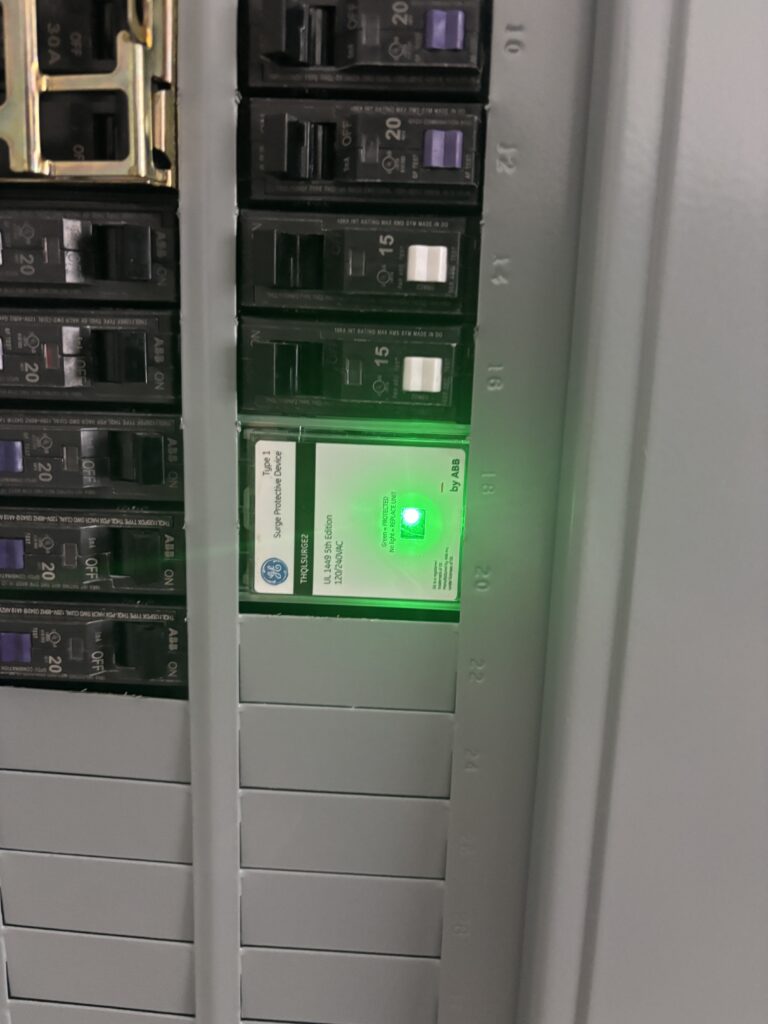
The damage a loose neutral causes extends well beyond the lights themselves. Overvoltage on one leg pushes far more current through resistive loads than they were designed to handle, burning out heating elements, motor windings, and electronic power supplies. Refrigerators, furnaces, computers, and televisions all fail early under these conditions. Homeowners often replace several appliances before anyone connects the failures to a single electrical root cause. Repairing the neutral stops the damage, and adding surge protection guards against the voltage events that follow. Click here to learn about our whole house surge protection service and protect the equipment you have already invested in.
Utility Service Damage Behind Flickering Lights After Kansas Storms
Not every flicker originates inside the house, and utility side problems account for a meaningful share of the calls electricians receive after storm season. The service drop running from the pole to your weatherhead endures wind, ice, tree limbs, and UV degradation year after year. Splices at the weatherhead corrode where dissimilar metals meet, and that corrosion adds resistance exactly the way a loose interior connection does. Late summer and early fall thunderstorms across northeast Kansas stress these connections repeatedly with wind loading and lightning induced surges. A flicker that started right after a storm deserves a look at the service entrance before anyone opens the panel. The dividing line matters, since the utility owns the equipment up to a defined point and the homeowner owns everything past it.
Neighborhood wide flickering that affects your house and your neighbors at the same time points squarely at the utility rather than your wiring. Transformer problems, damaged primary conductors, and switching operations on the distribution system all produce visible flicker across multiple properties. Checking with a neighbor takes thirty seconds and can save you a service call entirely. If the flicker is yours alone, the problem lives on your property. A licensed electrician determines the boundary quickly and tells you honestly which side of it your problem falls on. Reputable companies do not charge you for work the utility owes you.
Tree contact remains a persistent issue throughout Douglas and Jefferson counties, where mature hardwoods grow directly through overhead service lines. Branches rubbing against a service drop wear through the weatherproof jacket over several seasons until the conductors underneath make intermittent contact. That contact produces flickering that comes and goes with the wind, which makes it maddening to diagnose from indoors. It also creates a genuine shock hazard for anyone near the tree. Homeowners should never trim vegetation near service conductors themselves under any circumstances. Report the contact to your utility and keep everyone away from the area until it is cleared.
Why You Need a Licensed Electrician for Flickering Lights
Flickering lights sit in an uncomfortable middle ground where the fix might cost eight dollars or it might reveal a service that needs replacing. Guessing wrong in either direction costs you money, and guessing wrong on the dangerous end costs far more than money. A licensed electrician brings the meters, the training, and the code knowledge to sort a harmless symptom from a developing hazard in a single visit. DC Electrical HVAC Plumbing has served Lawrence and the surrounding communities with honest diagnostics and no sales pressure, and we tell you plainly what your home needs. Free estimates on service and installation mean you know the cost before any work starts. Financing is available for the larger projects that occasionally come out of these diagnoses.
When Flickering Lights Call for Emergency Electrical Repair
Certain symptoms move flickering lights out of the scheduling queue and into the emergency category, and homeowners should know the list. Lights that brighten on one side of the house while dimming on the other indicate a loose neutral and require immediate response. A burning smell, scorch marks around an outlet, or a warm faceplate all mean heat is building somewhere it should not. Buzzing or crackling from the panel is another symptom that never waits until Monday. Sparks visible at a switch or receptacle demand that the circuit be shut off at the breaker right away.
Shutting off the affected circuit is the correct first move while you wait for a technician to arrive. If you cannot identify which breaker controls the problem area and the symptoms are severe, shutting off the main is reasonable. Do not open the panel cover, do not attempt to tighten anything, and do not remove device plates to look inside. The conductors inside a panel remain energized above the main breaker even with everything switched off. Keep people and pets away from the affected area until a licensed electrician has cleared it.
Our 24/7 emergency service exists because electrical hazards do not schedule themselves around business hours. A loose neutral discovered at nine on a Saturday night is just as dangerous as one found at nine on a Tuesday morning. OSHA 80 certified and EPA certified technicians respond with the equipment needed to diagnose and correct the problem safely. Call us at (785) 596-3963 the moment you see the warning signs described above. Click here for our emergency electrician service and get help when you need it most.
How an Electrical Inspection Prevents Flickering Lights
A thorough electrical inspection finds the loose connections and worn devices that cause flickering long before they become hazards. Technicians check terminations at the panel, test devices under load, verify grounding and bonding, and evaluate the service entrance for corrosion or damage. Thermal imaging reveals connections running hotter than they should even when nothing is visibly wrong. The inspection also documents the condition of your system, which helps with insurance and with planning future upgrades. Most homeowners are surprised how much a professional evaluation reveals.
Timing an inspection well makes it more valuable. Early fall is an excellent window in Kansas, since summer cooling loads have already stressed every weak connection in the system and heating season has not yet started. Problems that hid through the mild months of spring show themselves clearly after months of heavy air conditioner use. Correcting them now means your furnace and heat pump start the heating season on a sound electrical foundation. It also avoids the scramble of an emergency call during the first hard freeze.
Homes over forty years old, homes with aluminum branch wiring, and homes that have recently added major appliances all benefit most from an inspection. Any home being bought or sold should have one as a matter of routine. Adding an electric vehicle charger, a hot tub, or a workshop subpanel also warrants a professional look at capacity. Click here to schedule our electrical inspection service and find out exactly where your system stands. An inspection costs a fraction of what a preventable failure costs.
Why Choose DC Electrical HVAC Plumbing for Flickering Lights
Flickering lights often involve more than one trade, and having HVAC, electrical, refrigeration, and plumbing expertise under one roof shortens the path to an answer. When a compressor startup drags your voltage down, our technicians evaluate the equipment and the circuit rather than sending you to a second company. That saves you a diagnostic fee and gets the problem resolved in one visit. Coordination between trades matters most on the jobs where the symptom crosses disciplines. Our team handles that coordination internally so you never have to.
Honest diagnostics with no sales pressure is a standard we hold ourselves to on every call. If your flicker is a loose bulb, we tell you it is a loose bulb. If your panel is a Federal Pacific with visible damage, we explain what we found and why replacement is the right call. You get the information and the estimate, then you decide on your own timeline. Free estimates on service and installation mean nothing is hidden until the invoice arrives.
DC Electrical HVAC Plumbing operates out of Lecompton and proudly serves Lawrence, Topeka, Eudora, Perry, Tonganoxie, De Soto, Olathe, Overland Park, and the surrounding communities. Our technicians are OSHA 80 certified and EPA certified, and every job is completed to current code. Financing is available for panel replacements, service upgrades, and rewiring projects. Call (785) 596-3963 or email info@justcalldc.com to schedule your appointment. We are dedicated to always providing a stellar service, and we would be glad to put your flickering lights behind you for good.